How to give FinOps authority without creating bureaucracy
Executive sponsorship matters in FinOps, but intent alone is not enough. This article introduces the FinOps Executive Mandate, a practical artefact that turns sponsorship into explicit authority, defines decision rights and separates a stable core from context-specific adaptation.

Turning executive sponsorship into something usable
In FinOps, there is broad agreement on one point.
To succeed, you need executive sponsorship.
What is less clear is what that sponsorship should actually look like once you move past intent and goodwill. Practitioners are often told they need a sponsor, but not what to ask for, how to formalise it, or how to make it usable once it exists.
Support is not the same thing as authorisation.
This article introduces a simple but often missing artefact: the FinOps Executive Mandate.
Sponsorship is necessary, but not sufficient
Most executives already make decisions that affect cloud spend. They decide how fast the organisation should move, how much volatility is acceptable, when predictability matters more than speed, and how risk should be managed.
These are economic trade-offs. They are strategic by nature.
FinOps exists to make those trade-offs explicit and consistent. It does not invent them.
Without a clear mandate, FinOps is left to operate through persuasion. Conversations are repeated, authority is renegotiated, and accountability remains diffuse.
A mandate does not add bureaucracy. It removes ambiguity.
What an executive mandate actually does
An executive mandate answers a small set of practical questions:
- What is FinOps authorised to influence?
- Who can it speak to directly?
- Can it introduce work, or only comment on it?
- Can it require time from other roles?
- Which strategic priorities should guide decisions?
If these questions are not answered explicitly, they will be answered implicitly, usually differently each time.
The purpose of a mandate is not to prescribe solutions. It is to define authority.
Applying the 80/20 principle
Most organisations struggle with the same foundational issues when starting or scaling FinOps.
Unclear scope.
Implicit priorities.
Assumed decision rights.
This is the common 80 per cent.
The remaining 20 per cent is context: organisational structure, incentives, operating models and politics. That part matters, but it is unique to each organisation.
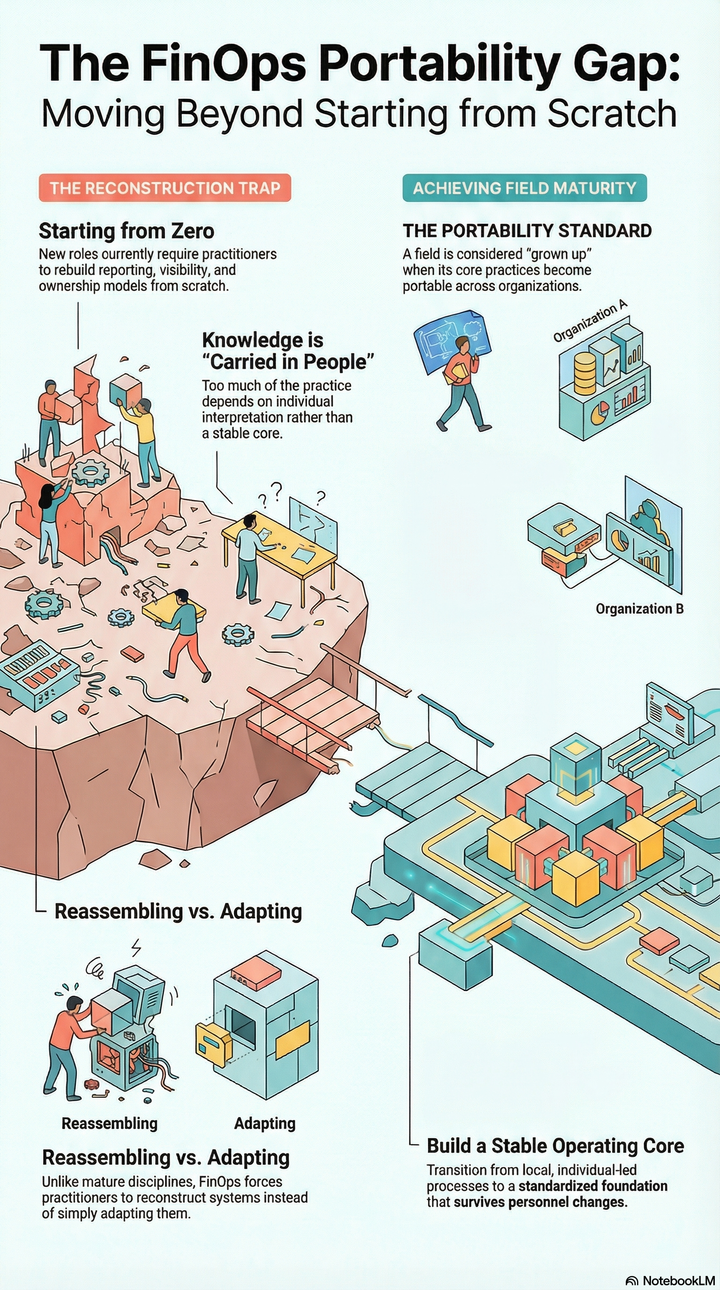
The mandate presented here is designed to cover the essential 80 per cent. It establishes a stable core that can then be adapted deliberately, rather than rewritten informally.
The FinOps Executive Mandate (high-level view)
The mandate is a short, formal document owned by an executive sponsor. It is designed to be read, discussed and approved.
At a high level, it does five things:
- It states why FinOps exists in this organisation.
- It links FinOps explicitly to company strategy.
- It defines what is in scope and what is not.
- It grants concrete decision rights.
- It names an executive owner.
The mandate is intentionally generic. It is not tailored to a specific company. That work belongs elsewhere.
Strategy first, trade-offs second
A critical part of the mandate is the link to company strategy.
FinOps does not optimise in the abstract. It behaves differently depending on whether the organisation prioritises growth, profitability, predictability, innovation or risk.
Rather than asking FinOps to choose trade-offs, the mandate requires executives to state their priorities. FinOps is then authorised to act consistently with those priorities, even when this creates local friction.
If strategy changes, the mandate must be revisited. It must not be silently ignored.
Authority must touch real work
A mandate that does not affect how work is done is symbolic.
For FinOps to be accountable, it must be authorised to:
- communicate directly with executives,
- introduce items into delivery backlogs,
- require dedicated time from relevant roles,
- document decisions and economic narratives.
Without these rights, FinOps can observe and report. It cannot act.
This distinction is often uncomfortable, but it is unavoidable.
Stable core, explicit adaptation
The mandate is designed as a stable core.
It should not be rewritten every quarter. Changes to the core should occur only when strategy, structure or ownership materially change.
Adaptation is expected, but it happens in appendices, not by modifying the mandate itself. The appendices capture local context, operating models, decision paths and constraints.
This separation keeps authority stable while allowing reality to be documented.
What this gives practitioners
For practitioners, a mandate:
- replaces repeated persuasion with reference,
- legitimises difficult conversations,
- clarifies where authority starts and stops,
- and makes accountability possible.
It does not guarantee agreement. It guarantees clarity.
What follows
The full FinOps Executive Mandate is available as a working artefact, alongside a companion guide explaining how to introduce it, identify the right executive sponsor and adapt it through appendices.
For readers with access, the remainder includes:
- the complete mandate in editable form,
- guidance on establishing it with executives,
- and practical advice on adapting it without diluting its authority.
FinOps Exec mandate template
The template and the guide explaining how to present it and secure executive approval are available to paying subscribers.