
Your strategy dies before it reaches engineering
Strategy rarely reaches engineers intact. As decisions are reworked at every level, intent fragments and organisations drift. This model shows how to carry strategy through intent, policies, and implementation—and why FinOps sits at the centre of making it happen.
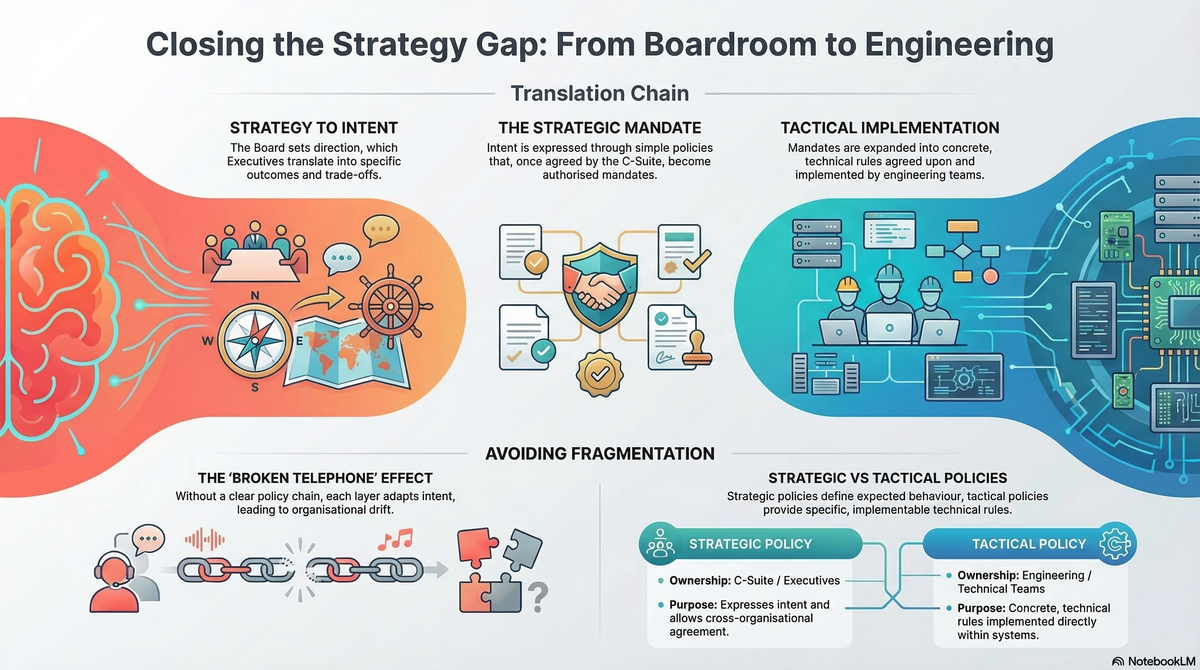
Your strategy dies before it reaches engineering
Some will recognise this immediately.
Over the years, working across executive and engineering teams, I have noticed that technology decisions are reworked at every level, like the broken telephone game. Strategy does not travel intact.
Strategy does not survive contact with implementation. This model prevents that.
Strategy is set at board level and delegated to the C-suite to make it happen. Each executive then defines intent for their area: how the strategy will be realised, what must be achieved, and which trade-offs are acceptable. The simplest way to express that intent is through strategic policies—simple statements of expected behaviour. These policies are coordinated across the C-suite until there is agreement on how the strategy will be applied across the organisation.
When these strategic policies are agreed, they carry authority. That authority makes them a mandate. This mandate must then be translated. Each strategic policy is expanded into one or more tactical policies, which are specific and implementable. They are discussed and agreed with engineers and other technical teams, and expressed in plain language so that anyone involved, with a minimum level of knowledge, can understand, debate, and agree with them. Once agreed, they are implemented in systems.
The chain is simple: strategy leads to intent, intent is expressed through strategic policies, strategic policies become a mandate, and that mandate is translated into tactical policies that are implemented. A broader version of this logic, including the organisational layers that sit between strategy and execution, is explored in The Shape of Top-down FinOps.
This is where most organisations struggle. Sometimes, even the initial strategy is unclear, or expressed too loosely to be understood, even within the C-suite. Strategic policies are unclear or absent, and the conversion into tactical policies is inconsistent. Each layer adapts the intent in its own way, leaving individuals to decide what the intent means.
The result is not failure of execution. It is fragmentation of intent. The organisation drifts.
It is time to look at your FinOps practice as a trusted partner to turn intent into reality.
These concepts are explored in more detail in my workshop, currently running in the US, with upcoming sessions in Texas and on the West Coast in April. The workshop uses different company scenarios and simple ad-libs to make policies easier to write and agree.
Glossary
- Strategy: Direction set at board level, defining what the organisation aims to achieve.
- Intent: The translation of strategy by each executive into outcomes and acceptable trade-offs for their area.
- Strategic policies: Simple statements of expected behaviour that express intent and allow agreement across the C-suite.
- Mandate: Strategic policies backed by authority, carrying the power to be applied.
- Tactical policies: Concrete, technical, and implementable rules derived from strategic policies, agreed with engineering and technical teams.
- Implementation: The enactment of tactical policies within systems and processes.


Comments ()