
FinOps wants to grow. It might shrink instead
As cloud approaches trillion-dollar scale, it becomes infrastructure. FinOps practices standardise and disperse into finance, engineering, and procurement. What remains is not optimisation, but context; translating strategy into coherent decisions across the system.
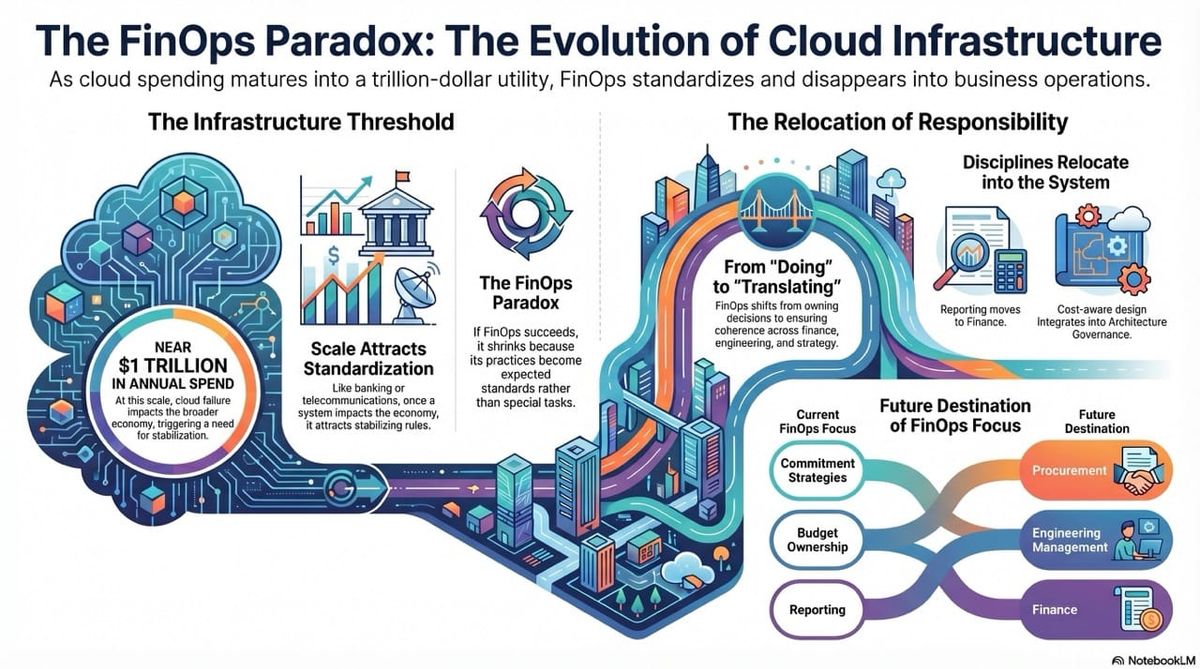
Cloud is reaching a point where it acts like infrastructure, not just a technology market.
Spending is now in the hundreds of billions, nearing a trillion dollars a year. At this scale, failure spills into the economy—affecting transactions, logistics, and revenue.
When a system grows that large, it attracts standards. Electricity, banking, and telecommunications followed this same path. Once failure impacts the economy, rules are created. These rules aim to stabilise the system, not to improve it.
Cloud is now crossing that threshold.
When standards arrive, they subtly change a discipline. Accounting was once a craft. Today, it’s embedded everywhere—through rules, reports, and roles. The work didn't disappear; it integrated into the system.
A similar trend is beginning in FinOps. Right now, FinOps holds together what isn’t stable: cost allocation, commitments, forecasting, and architecture trade-offs. It exists because no single domain encompasses it all.
As patterns stabilise, they shift. Commitment strategies evolve into procurement. Budget ownership transitions to engineering management. Reporting becomes finance. Cost-aware design turns into architecture governance. The practices don’t vanish; they relocate.
This creates a paradox. If FinOps succeeds, it shrinks. Not due to failure, but because it worked. As the discipline proves its worth, it becomes standard. Once it’s standard, it’s no longer special; it’s expected.
This raises a question: what stays?
Not optimisation, but context. Organisations don’t operate in a standard environment; they function under specific constraints—growth, regulation, margins, and risk. Standards offer a baseline but don’t dictate how to apply it.
Someone must still translate. From finance to engineering, from policy to implementation, and from strategy to trade-offs. FinOps shifts from doing the work to making the system coherent. It stops owning every decision and begins ensuring there are no conflicts.
At scale, cloud becomes part of the economic foundation. Like previous infrastructures, the discipline around it fragments, standardises, and merges into the system.
The question isn’t whether FinOps will grow. It’s whether practitioners are ready for what remains.

Comments ()